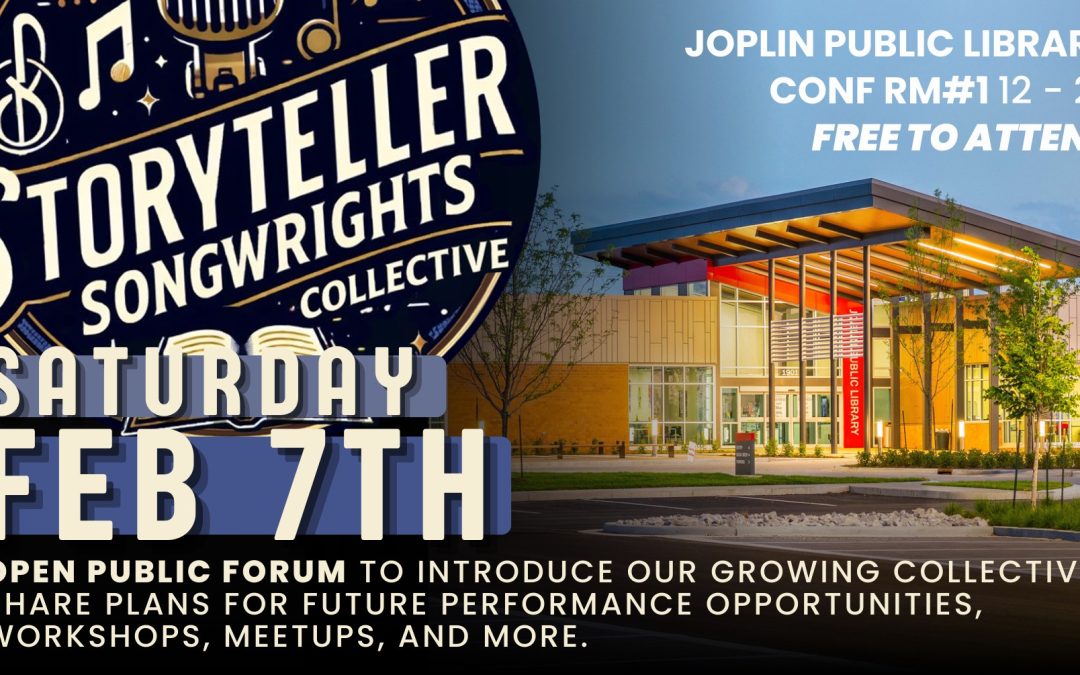
The local arts community in the Four States region just got a little tighter. On February 7, 2026, Storyteller Songwrights co-founders Trevor C. Smith and Caleb Miller hosted a public forum at the Joplin Public Library to share their vision for a more connected, collaborative, and paid songwriting community.
For those who couldn’t attend the live stream or the in-person event, here is the breakdown of what this growing collective is doing to elevate the craft of songwriting in Joplin and beyond.
More Than Just a Performance: Our Mission
At its core, Storyteller Songwrights is built on the belief that a song is more than just melody—it’s a connection. The collective focuses on “round robin” style showcases where artists don’t just play; they share the stories, inspirations, and “why” behind their lyrics.
The Three Pillars of Storyteller Songwrights:
- Paid Opportunities: Unlike many open mic nights, the collective prioritizes creating paid performance slots for original music.
- Storytelling: Encouraging artists to introduce their songs and connect deeply with the audience.
- Community Mentorship: Providing a “safe space” for songwriters at any level—from first-timers to seasoned pros—to gain confidence and grow.
“We want to create an environment where we are in a creative space. There is no wrong. It’s a safe space for people to come play.” — Trevor C. Smith
What Storyteller Songwrights Is (And Isn’t)
To help the community understand their role, Caleb and Trevor were very clear about the collective’s identity:
| What We Are | What We Are Not |
| A Collective of Songwriters | A Booking Agency |
| A Networking Hub | A Record Label |
| A Trusted Regional Brand | A Marketing Company |
| A Performance Platform | A Traditional Band |
The goal isn’t to sign artists to contracts; it’s to build a trusted brand where venues and audiences know that if “Songwrights” are on the bill, they are in for high-quality, original local art.
Milestones & The Growing Alumni
Since their first showcase in June 2024, the collective has hosted over 20 events, featuring a diverse roster of local talent. Notable alumni include:
- Eric & Erica French (Acoustic Duo)
- Vagabond Grove (Caleb Miller)
- Lauren Fisher
- Killer Cole Doris
- Cousin Sleepy (AJ Roof)
- Karl Keczkemethy (Who performed his first-ever live show with the collective!)
Upcoming Events in the Joplin Area
The collective is expanding beyond its “proving ground” at JB’s Clubhouse to more public venues across the region. Mark your calendars for these upcoming sessions:
- February 21: Special Showcase at Zinc Coffee (Sponsored by Club 1201 / Palin Music of Joplin / Event space by Zinc Coffee / Posters Sponsored by Eagle Eye Printing )
- March 7: Monthly Showcase at JB’s Clubhouse
- March 21: Showcase at Honey Pops in Anderson, MO
- April 2026: (Tentative) An elegant songwriter affair at Club 1201
How to Get Involved
Whether you are a songwriter looking for a stage or a local business wanting to support the arts, there is a place for you:
- For Songwriters: Visit the official website to fill out a performer interest form. All you need is 5 or 6 original songs to get started in a showcase.
- For Patrons: The best way to support the movement is to show up and show support to their favorite songwright. Many events are free to attend and offer a unique, listening-room environment.
- For Sponsors: The collective relies on “sweat equity” and local partnerships. From printing credits (like Eagle Eye Printing) to sound equipment (like Palin Music), every bit of support helps pay the artists.
Storyteller Songwrights is proving that songwriting is a fine art, deserving of the same spotlight as a gallery painting or a jazz masterpiece. By bringing musicians out of the “middle of nowhere” jams and onto local stages, they are shaping a robust future for the regional music scene.
Watch the Video
Video Transcript: "Nice, Johnny Donald, I'm Eric, Eric French. Eric French, I've told you an acoustic duo. What was your name? Joe Pinnett. Oh yeah, we're on that. We're on that. What are you doing here? He doesn't know. He's met me once before at a jam out in, what was that called, man? Moss, Oaky Moss Jams or something? Mossberg or something like that? Mossy Oaks. Mossy Oaks. That's it, dude. Out in the middle of nowhere.
I was like, I'm not from here. I just drive up and I'm like, I got to take this dang directions out into the middle of the woods. And I pull up and I'm like, is this the place? And I'm like, I'm physically getting shot at, being out here from the property. So yeah, I know I drive up in there and it's like, oh, there's a guy waving me in. He does construction. He's a super cool guy. Kyle. Kyle Tracy. Yeah, Kyle Tracy. Yeah, it was the first time meeting him. So I met Ed out there. Turns out Ed plays too. He's Joplin Musicians page on Facebook. He likes to share all of them.
He likes to share all of our stuff. Super cool part of the community. I figured there'd be a lot of that here today. So yeah. Well, people are just lost. Possibly. We'll filter in. Yeah. We are all sensor love. Yes.
Oh, is she?
We were just there.
I didn't see her, but I saw...
Jessie?
Yeah, we were just there, and she was coming in as we were leaving.
Yeah, I saw them hanging there.
I was like, oh, Kayla's been here.
Yeah, my other thing is that.
That's cool.
So they hadn't seen that yet.
Everybody was like, didn't know what flyer I was talking about.
I was like, yeah, we're on the first one, or the second one over here.
Hey, man, thank you so much for coming.
Sorry I'm late.
No, you're not.
We're actually just getting started.
We paused for a little while, and we went live on Facebook.
We're live right now, actually, guys, but we wanted to do that so that we would have an opportunity to share what we're doing here with more than just those who were able to come.
We noticed when we sent out the email that a lot of folks were hit and miss with time and dates and such, so we wanted to find the most vanilla moment we could to bring people in.
And then this will be something that we're hoping to do a little more frequently.
We weren't sure what to call it, you know, but we wanted to create an opportunity for the songwriting and music community to come learn, first of all, what we're trying to do, what our intent is.
What our intentions are, what we've been doing.
And also, the next time we do this, we might do it somewhere else.
We've talked to paneling music, and they're interested in having us be able to have something like this, where we can just meet up and talk about, you know, what's going on in the music community, venues, opportunities to play, anything else to really try to empower our wonderful and really robust group of songwriters we have around here.
We have a lot of fantastic songwriters, and I've had the opportunity to play with so many of them, and I'm very excited about it.
I love it when we come together, and, you know, Cole's a friend now, you know, and we share that.
And not only that, like, we're getting to know each other in ways that I think helps improve the community.
So networking is a big part of all of this.
We'll all start collaborating, too, now.
And now we're on each other's songs.
For sure, yeah.
Right.
Yeah, I'm definitely writing this guy.
I hope so, too.
Yeah, that's one of the plans.
We'll talk about our future plans here in a bit, but we're going to go ahead and get things going.
Yeah, here we go, guys.
So welcome.
I think we've already said that to most of you all, but here's kind of what we're going to talk about today.
We'll have some introductions, talk about ourselves and the group as a general, our mission, what we do, some of the upcoming events we already have on the calendar,
how you all can get involved if you're not already.
I know a few of you are, a few of you aren't.
And then the main thing we really want is we want some feedback.
We want to know what you guys would like to see and what the general community needs right now and how this could potentially fill some gaps in there.
So that's kind of what we're going for.
So I'll pass it back over here to Trevor to just kind of introduce himself and introduce myself as well.
So most of you over right now already know my name is Trevor Smith.
Hi, Trevor.
Thank you.
Thank you.
The C is just so that I'm just not some regular Smith.
No offense to Smiths out there.
There's a lot of us.
I was born in Kansas City originally.
What's that?
I'm a Miller.
I was born in Kansas City.
I moved down here in 89 in Carthage.
I've lived there ever since.
I graduated from high school there.
I have deep roots in this area and I love it very much.
I've recently moved to Joplin.
My life has moved over here so I spent a lot more time over here.
I started playing guitar in 1999.
A little late for a lot of folks that I felt at the time.
Most people that I was going to school with that played played way better than me and so I felt way behind.
When I started, I really took to it.
I would play for hours and hours a day and just try to get as good as I could so I could start writing songs because I wanted to be a songwriter.
I'm self-taught for the most part.
I went to college for maybe in total a couple of years.
I took one semester of a folk guitar class.
I got looked at weird every time I tuned my guitar just because I was different in there.
But overall, that's the most music training that I have.
Everything else has just been by watching and mimicking other guitar players and seeing what they're doing and picking up their styles.
I founded and played in a band called Ebonflow from about 2002 to 2012.
We played hundreds of shows.
We traveled around and played down in Texas and areas around like that.
We were mostly an original band.
I didn't want to be a cover band.
I wanted to just play my own music.
So we did that and had a lot of fun.
I've written well over 50 songs at this point, which may or may not be a lot.
But to me, it feels like an accomplishment to have been able to create that much with something that I love so much.
And most of them probably will never see a stage, but I'm very proud of that.
My most influential artists are Mark Tremonti from Creed.
I fell in love with Creed in 1998, and it made me want to play music, so I started playing.
And I started learning by reading tablature, even though I didn't know what I was doing.
And I just learned from there, and then I found other bands I loved, and then I found ways to take inspiration from them.
Songwriting, lyrics and stuff.
Eddie Vedder was a big influence on me.
Tom York.
Dave Matthews, both guitar playing and lyricism is something that I would sit and read their lyrics, and I would carry a dictionary around with me, and I would just try to absorb myself in the craft as much as I could.
And I've been a passionate songwriter for a long time, and I took a break for about 10 years, came back, and I wanted to play my music.
I don't want to do covers, you know?
And so I wanted to create an opportunity to do that, and so that's kind of where this has all come from.
I'm Caleb Miller.
I also go by Vagabond Grove as a performer.
So I'm originally from Monette, but I've lived here in Joplin for about 10 years or so.
I went to college here, and now bought a house, and raised my family here.
I started playing music very young.
My mom was a piano teacher, and so she wanted to remember those I had learned.
She did give us a choice.
She said we could learn piano and be happy, or we could learn piano and be miserable.
So I did.
I started songwriting about at the age of 11 or so, before I was even good enough on any instrument to actually write, like anything.
So it was just melodies and lyrics.
I eventually started figuring out the guitar and kind of reteaching myself the piano so I could actually write, and I've been doing that ever since.
I've been performing more or less professionally since I was probably about 18 years old.
This is most of my job now.
I perform.
I teach.
I do this kind of stuff as well.
Yeah, influences for me, I didn't actually write any down, but I grew up kind of weirdly on a lot of 60s and 70s stuff.
My parents were 80s kids, but my brother introduced me to Beatles and the Stones and the Who and Floyd and all that stuff, and I got into that early rock and roll.
I fell in love with just really simple folk tunes, probably from listening to Bob Dylan and then more modern artists like Passenger, Noecon, Luminere, stuff like that.
But I also played a lot of jazz growing up, so I included a lot of that stuff and played in the Missouri Southern Jazz Orchestra and things like that as well.
And yeah, I have played on probably four or five, six, maybe.
I don't know any more of these events.
Trevor started these probably about two years ago almost, and I played on I think the second one and several others since then.
And back in probably October or so, he asked if I'd be interested in joining and kind of making this a little bit bigger than what one person could do.
So we're going to talk a little bit about what Songwrites is, and here we go.
Here's our mission.
I think we're going to do this one.
Okay, yeah.
So our mission is to create paid performance opportunities for songwriters.
There's plenty of opportunity out there to play and get paid, but we want to create it specifically for songwriting.
And we want to weave in storytelling because we believe that the connection with the audience happens whenever they can relate to you.
So part of this whole thing is really just not just coming and playing and show and playing music, show up, play, and leave.
It's come, show up, introduce yourself, introduce your song, tell the story behind it, and then play the song.
And then do that over and again throughout the show.
So the showcase is, you know, it's a four-man round robin, and we'll talk a little more about that, where it kind of forces that thing.
We want to create, like I said, the connection with live music, art entities, and venues as well.
So we want to also take storyteller songwrites to venues and have them be excited about having it there, regardless of who is playing the actual show.
So when you become a member of this, and the only entry point is a showcase, and just being a part of it and playing shows, you get paid to play every show.
The showcase pays right now 50 bucks.
We're going to work on trying to get more money for these events, and we'll talk more about how we get money for the events later on in the showcase.
Or in this presentation.
But we want to have venues be excited about having us there.
We want artists to be excited about being a part of something like this, where they can, you know, feel accredited in some way.
That's something more than, yeah, I'm on YouTube.
Yeah, I'm on Spotify.
No, I'm a part of this thing that is trying to create a healthy and rich cultural experience in our community.
So the trusted brand part of this is really just the songwrites brand itself.
It's like we want people to be like, oh, songwrites are going to be here.
And, you know, we can have several shows going on at once right now.
So we can have someone at a coffee shop playing, someone at a bar playing, someone out here at the public library playing.
It doesn't matter.
The idea is like it creates opportunity for everyone.
And whenever that opportunity is available, I'll reach out by email and send out these dates.
And if first come, first serve, it's just the way that it is.
If you want the date, you let me know.
And I'm going to try to get you in there.
First come, first serve.
And if I can't, I'll let you know.
And I'll present you with other opportunities.
We want to foster a healthy community that elevates our local music scene.
One of the most profound things to me that I have experienced in all of this has been how few of the songwriters and musicians in this area really know each other.
I've introduced numerous ones.
I'm not just introduced them.
I've met them for the first time myself.
You know, Eric I met for the first time out front of Porch Fest.
He showed up.
He's like, hey, man, I like what you're doing.
I want to be a part of it.
How do I get involved?
I was like, have five or six songs and you can come to a showcase.
He hits me up like a year later.
He's like, hey, man, I'm ready.
Dude, I didn't take you serious.
When you showed up ready to go, I was like, let's do it.
I was so excited.
Dude, I was so excited to have you come play.
We're doing this now year.
Yeah.
In April.
That's wonderful, man.
I'm so happy for you guys.
I appreciate you again with the songwriters.
You guys are.
I enjoy you guys so much.
I'm very excited to have you be a part of it and the fact that it's grown that way.
I love the story.
Thank you.
We also want to elevate performance songwriting.
A part of that is really just trying to give the space for it to happen.
I don't want to say judgment is one of those things that I think for me, I'm concerned that
I'm going to do a bad job.
We want to create an environment where that's less of an issue, where we are in a creative
space.
There is no wrong.
It's a safe space for people to come play.
A lot of the showcases that we do play right now, there's not a ton of people there in
the beginning.
You get comfortable because you're around other people who are experiencing the same thing.
And then you get a chance to play in a place where it's kind of like curated and made for
you to kind of become more comfortable with playing live.
So a part of what we want to do is, again we'll talk about this a little later on, is create
opportunities for songwriters to play at any level.
Any level.
You come play and we're going to do our best to mentor you and share experience with you
and help you grow into becoming a more, what's the word?
Not courageous, but confident performer.
Yeah.
The word is gross.
I'm just, I'm cooking over here.
I'm just.
Oh, okay.
No worries.
I can move those down.
We can dump that.
I just wanted to wear black.
I just wanted to wear black.
I tried to slide in here without it washing out of the house.
Yeah, that'll probably help a little bit too.
Yeah, it's certainly not.
So, I don't see on here, Caleb, do we get into the booking agency stuff?
Like what we're not?
What we are?
I don't think I'll put that in there.
Okay.
If you want to talk about what we're not, that's a very important thing.
Yeah, I do want to do that.
There's a few things that we're definitely not.
Yeah, so, when I talk to people about this, especially like, I don't know, just folks who
kind of get this idea about what I'm doing, I want to say what we're not.
Okay, so we are not a booking agency, all right?
We are not a band.
We're not a label.
And we're not a marketing company, all right?
We are not anything other than songwriters, he and I right now, and anyone that I refer
to as the alumni, people who play the show.
We are just a group of people who are trying to take a little more ownership over opportunity
and then give that to other songwriters.
Yeah, we certainly have a few of those elements.
We're not trying to do that.
We're not trying to do that.
We're not trying to do that.
We're not trying to sign anybody and get them on our, you know.
Yeah.
We certainly want you to be part of our collective, but that's not like a contractual obligation
of any kind.
No.
Other than we just ask that you play a show every night and you want to be part of the group.
Yeah.
And that's a paid opportunity again, so we're not really asking for anything super, you know,
demanding.
Some historical details about the song, right?
Collective.
Our first showcase was June 1st of 2024.
It featured Lauren Fisher, Carl Kex Methy, Clay Hughes, and myself as host.
Clay is from Kansas City.
He came down to play in that one.
I don't know if any of you know who Lauren Fisher is, but she's a phenomenal songwriter and singer
in the area.
And Carl, I believe that was his first time playing live.
He had only been playing for like maybe a couple of years.
He'd never played a show before.
He's done two if not three of our showcases.
He was on the last one this last January that I was on.
We've done 21 showcases.
Tonight will be our 22nd.
This flyer that you see in front of you is what we're calling a special showcase.
Our showcase is generally the first Saturday of every month, but I'm looking to expand, or
we are looking to expand the songwrites' opportunities outside of JB's Clubhouse where we have that.
And this one is going to be taking place at Zink Coffee.
It's free to attend if anybody wants to come to experience what the showcase is.
That is a free show.
Our sponsors on that, which we are grateful for, a little sneak peek into what that means.
1201 has basically funded the show.
So the money that we will make as artists will be brought to us by our friends at Club 1201.
Palin Music will be providing sound.
They will come and set up a PA system for us to play through.
And then Zink Coffee is offering the space for free.
So we want as many people to come experience this unique live music event as possible.
It's important that we spread the word and get people to know, because there are people out there who truly love music for the craft of songwriting.
We want people to appreciate it as an art form, not just as background something to shake your booty to.
I want that for myself.
What's that?
I mean, you can still shake it.
You know what I'm saying?
But that's not our intention.
It's not about partying.
Albeit there's a time and place for everything.
And I have no qualms with that.
I will play to those crowds if that's the space that I want to be in.
But I want to create this second thing.
This other thing.
So I just want to list off some of the names of the folks who have played in our event.
Eric and Erica French have been in several showcases.
Jeffrey Salem.
Killer Cole Doris.
She's done several of them.
Elijah Jones.
Drew Baxter.
He played last night at a JV's Live.
Rick Tracy.
Tough luck Chuck.
Who couldn't be here, by the way.
But he did let us know.
She's his grandkids.
I don't know if he's all alive or not.
AJ Roof, a.k.a. Cousin Sleepy.
Randall Shreve.
Conrad Linsmeyer.
He's out of Northwest Arkansas.
Chase Carlisle has played.
Samantha Hunt.
James Weaver.
Keevan Dunn.
Zach Williams.
Terry Wayne Conder.
Lauren Fisher.
Quentin Scott.
Max Lemaster.
Olivia Wu.
Alex Simica.
Dahlia Neal.
Clay Hughes.
Caleb Miller.
Matt Long.
Carl Kecksmethy.
And Garrick Fawcett.
Those are, I believe, everyone.
And we have tonight three new folks coming who have never played before.
We're very excited to hear them.
So, some of the other things that I think that we miss out on the mission is, it's our intention
to connect with other playing opportunities in the area, not just venues.
But Porch Fest is something that we're trying to work out opportunities with.
Speaking with them on maybe having our own porch.
So, even if you do come play Porch Fest, then there might be another opportunity to come stop by the songwriter porch.
But we're still working with them on that.
Connect to Culture is another one that we want to get in touch with to see if we can bring this to the, help me out here.
Ernst?
It's not Ernst.
Why am I saying Ernst?
Thank you.
I can't believe, yes, Harry is where I went wrong on that.
But I would love to really get this brought to that stage as well.
I think that would be great for the arts, the local arts.
Yeah, I mean, one of our big beliefs is that, you know, songwriting, some people are doing right now is just as good as, you know, it can be just as good as Bach, Beethoven.
Yeah.
It can be as good as the jazz greats.
Just because that stuff's older doesn't mean that it's any kind of, you know, better.
It doesn't mean that it's any intense.
And so, we want to really kind of bring this to that level with fine arts.
You know, we want to be able to be on stage as a show that that kind of music is being made now.
There's great, great songwriters out there.
Yeah.
I also feel if people would feel compelled to want to come look at photography and paintings, those are arts.
And so is songwriting.
And it doesn't get the spotlight I feel like it could.
How we do that, I'm not exactly sure other than just keep bringing it to the people and telling them this is what you're experiencing.
This is fine art.
This is local art.
The same as the painting on the wall.
And here is how we're bringing it to the people.
So, we have three different types of shows that we're currently running.
The main one that we've talked about the most right now is the showcase.
That is our generally monthly, although now it's becoming kind of a bi-monthly thing.
We have our first Saturday at JB's.
And now this month and next month we have a second one.
We'll probably try to have a second one most months this year.
But this is a four-songwriter round.
So, usually we try to have everybody on the stage.
You're going to play one song, tell the story behind that, and you're going to move on to the next one.
You get to usually perform about four to six songs in that.
Then we have our sessions, which we've only done one of so far.
Myself and Trevor, we teamed up with Joplin Improv last, not last, not December now, to do a quick little kind of a showcase before their performance is more folks interested in what we're doing.
But this is going to be a two-artist song swap, so we still have some variation.
But you get to play a little bit more music, and these will be a little bit higher paid as well because we're splitting it into four artists.
And then finally we have our spotlight, which just started, I think, this past August or so.
And it is every single week we have somebody at JV's, if it's not a showcase week, who is just doing just themselves or a duo or however it may be set up, where you get to do all your own music all night to tell all your own stories.
Who's this weekend?
Oh, this is a showcase tonight.
It's a night's showcase, and then I know...
I don't actually remember who was all on the list right now.
We could look it up here.
Very hip, Todd Osborne.
Yeah.
Osborne, and I can't think of the...
It's a classic tonight.
Yeah.
We're going to get to that as well.
So these are just kind of what we're working on right now.
We have some possibly some future stuff that we're looking at as well, but this is our main stuff.
Again, most of our stuff happens over JV's because they've been kind enough to fund us, basically.
Every week can give us at least a little bit of compensation for that.
And then we're obviously working on getting it out to more spaces because we recognize that not every space is for everybody.
We're certainly a cannabis lounge isn't for everybody, although it's a plus for a lot of us.
You know, and so that's where the Zinc comes in.
That's where all of these other venues come in.
So I think the next part is our upcoming events.
Do you want to talk about those right now?
Yeah.
So tonight...
Hey, we were trying to remember the names.
They're all right here.
So tonight we have myself hosting, and then three new songwrites will come and perform.
And for the first time, experience the showcase.
February 21st, which is this flyer in front of you for most of these showcases, we do not print materials for.
The primary reason is, one, the venue has chosen that we market within the venue, not outside of the venue for it.
Anything that's outside of that, we will get printed material for, which, by the way, Eagle Eye Printing has been kind enough to support us with a credit of up to $25 for printed materials.
So we have that where we're trying to make sure that anything that we're doing, there's offset in the cost.
So getting businesses involved with this to support the local arts, that's one of those things I wanted to mention.
Question.
Why wouldn't the venue want you to promote it?
That venue is a private club, private organization, and they choose not to market in traditional ways.
Yeah, JV's is run as kind of a members-only kind of situation.
It's open to the public, but you sort of have to purchase like a day-to-pass kind of situation.
Yeah, you have to be a member essentially to come there, but they offer like day memberships and monthly memberships if you want to do that.
I will post on our own channels for this event personally, but they do not promote anything other than the fact that the event takes place there.
But with regards to this event, we do have dollars that have been donated to us so that we will do digital advertising.
There's a lot of people who are performing on these.
That's why you probably will see a lot more advertising for stuff that's outside of JV's.
It's not, we're not trying to stiff anybody.
Yeah.
It's just that's the situation with that particular venue.
That's what they've asked of us.
Other venues are a little bit different.
We'll have these posters up.
We'll have more posts out.
We'll be able to also pay for some advertising online on those.
JV's just kind of operates a little bit differently.
Yeah.
We'll be very thankful for them because they've been funding this for almost two years.
Yeah.
I mean, he's, well, not he, but the organization itself has funded the vast majority of all the
people who have been approving ground for this whole process.
Yeah.
So very grateful.
JV's Clubhouse and the MOVE community have been a significant contributor to all of this.
March 7th, that's another showcase at JV's Clubhouse.
Your events, you'll notice I'm the host the majority of the time.
That's just been how it's been because I've been building the events.
Caleb has done one.
And because we are a collective, I do hope that we'll find other people within it that would be
interested in doing hosting duties, which just basically means that you make sure that people
know what's going on.
you kick off the show, you tell the crowd what's happening.
There's very little responsibility involved in it, but it is something that I feel like
someone's got to kind of like head the charge on.
March 21st at Honey Pops.
That's one that we're currently working on right now.
Looking for sponsors.
No, Honey Pops has sponsored the entire thing.
So as a matter of fact.
I'll just have a couple little details we're going to work out and we'll officially consult.
Yeah.
I think we've almost got time on that, so I will have that to you soon.
And then I'm softly working on one in April as well, hoping I can get book 1201 and create
something that's a little more of an elegant affair if that's possible.
Still looking for sponsors on that.
So what do we have next?
So as far as getting involved, depending on where you're at and what you're interested in doing,
we have a few different ways.
So if you're a performer, the best way to get involved is on our website itself, which I believe
that QR code that's on the posters just takes you straight to the website.
That's where our form is.
Fill that out.
Again, generally speaking, we will accept it and we'll get you on a showcase as soon as we can.
If you let us know what dates you've got available.
And then that's kind of what we do is kind of that JB's showcase is sort of our kind of proving ground,
we've been calling it.
It's sort of like, well, you know, that's where we were pretty accepting as far as anybody coming in.
And then these other showcases, especially the spotlights and some of these special showcases are kind of, you know,
we want to see what you've got and make sure that you really know what you're doing and you're confident.
That's where some of that, if it's a situation where you're maybe not, then we will hopefully be able to have time to, you know,
work with you and show you kind of what we're doing.
As far as patrons, really just coming out to shows is the main thing we want from patrons.
So again, all of these shows we have available, some of them for public, some of them a little bit less.
So, but it doesn't happen without the support.
And then as far as sponsors, if anybody's interested in sponsoring it, we need some of that.
We don't have like huge costs right now, but we definitely have a show at least once a month right now
that needs essentially paid for $250 to $400 somewhere in that vicinity,
depending on if we have to run sound and things like that.
So if you know of a business or you are a business that wants to sponsor us or even just donate just straight up to help us pay for that kind of stuff,
that is really, really helpful.
And then also just looking towards myself and Trevor put a lot of work into this.
And right now we're doing it mostly out of the kindness of our hearts we're doing because we really like this.
And it is a lot of work.
I know you put a lot of work in that I'm probably not even seeing.
And so that's hopefully something we're going towards.
We've been able to do a little bit more with this project and we can get some more funding.
Yeah.
So primarily all sweat equity at this moment.
My company does essentially sponsor our website.
We host it.
I'm doing the work on it myself.
Some of the goals that we have with that.
We'll talk about that in a little bit.
But we want to create opportunities for local businesses to invest in the songwriting community.
So we will present options for them.
If they want to pay for this part of it, if it's the performers, then we'll give them that opportunity.
If they want to give the space or some other thing.
Right now the configuration is anyone who wants to contribute can contribute.
It just has to make sense toward the show.
And then at some point if we can actually get sponsors to where like even their small dollar sponsors,
we'll just have a little bucket that we fill up until we get to the point that we have enough to put on a show.
And then we'll go find a venue to put it on.
We'll pay performers to play it.
We'll spend the money we have allocated on promoting it and do what we can to try to drive traffic towards it.
Yeah, that's a really good point.
It's not, certainly dollars are part of what we need.
But definitely we've got Paylan, for instance, sponsoring us by providing sound.
We've got Eagle Eye sponsoring us by providing the materials for us.
So we need, we have other needs that are simply monetary.
Yeah, the PA system is another thing.
Like we don't have funding for that.
And we certainly don't expect anyone to just give it to us.
So, you know, we want to create opportunity there for anyone who can provide sound.
Paylan is a good partner.
That guy at Dan was super excited to help us out.
He even wants to have showcases there and songwriting events there.
And also like team meetups like this that we could have in the music store.
He's offered that all to us.
So Paylan's been really generous to us.
And they're looking for more sponsorship opportunity where they can provide more if they could provide more.
So I think right now, because we've hit our 22nd showcase, we've got 26 spotlights.
We have a lot of history now to where when we go in and ask for things from businesses or ask from anyone to help us, they're very eager to.
Because we're not just an idea.
We are action at this point.
And we are bringing the talent wherever we're coming.
What are our future plans?
Yeah!
Stuff we're wanting to work on that currently, some of it is in work.
Some of it is just kind of ideas right now.
We also want to get your thoughts on them as well.
So we've been talking about doing some workshops of some kind, which would be kind of similar to this sort of vibe.
Although we would either bring in other songwriters or potentially do it ourselves.
We would just simply talk about both songwriting and specifically storytelling.
That's one of those things that I don't know if we carved out quite enough.
Because certainly there's a lot of great songwriters out here, but our big focus is also that storytelling element.
That's something that I actually, prior to even joining this, probably about two or three years ago, really started to push my own storytelling and song.
It really kind of turned things around for me.
I'm starting to get a lot more people coming up to me and talk to me about merch.
And just things started to get a lot better.
And I realized the storytelling with them really had something going on.
So in addition to trying to write really good songs, I've been really trying to focus on how can I also talk about my life and the things that inspired these songs.
And I find that really, really connects people to that.
So hopefully we'll work on some workshops that focus on storytelling specifically, as well as some of the songwriting.
Some regular meetups that may just be casual, conversational, maybe jam nights, maybe collaborations is kind of the next thing here.
So I know there's some folks in here who maybe write but don't sing or maybe sing but don't play or whatever that may be.
And those are some situations where we can maybe pair some people up that we know sound really good together.
Or just artists that are already playing and writing stuff and just want to maybe write some stuff together.
We're talking about some education and coaching, what that would look like specifically beyond the workshops themselves.
You know, might be a situation where somebody wants to perform but is just not confident enough yet.
Is maybe a new songwriter or a young performer.
And that might be a situation where we get kind of a one-on-one or a group setting where we get people together.
Just maybe walk them through a mock performance.
Show them kind of what we're looking for and what they can do.
In addition also just the showcase itself is kind of designed to be educational too.
We want to have seasoned performers and new performers on the same shows.
Like what you can watch and see okay this is what they're doing and this is then what I can kind of add to what I want.
And then some website features.
Our hope is that anyone who is kind of officially part of our collective, which really is anyone who plays on our shows, is officially part of this collective.
If you want to be on our website, we would be doing like basically a page where you can have your bio and your links and all this stuff.
We're open to also have a QR code that takes you to those pages so that you can add your cash app and Venmo's and things like that.
And we can continue straight from there and we can help facilitate that.
We'll probably go straight to your own thing. We're not going to try to touch the money if we can help with.
Yeah.
But those would be one of those things we have a page for each artist as well.
That will be something that will be coming sooner rather than later.
I will likely have a few of those up before the 21st.
At least those of us are playing on there and then we'll be still building it out before anyone who's interested in being a part of that.
Yeah, I just have to get the templates and stuff going.
But for this 21st event, I want to have opportunities in place for folks to be able to get some extra compensation beyond.
I don't want to touch people's money. Storyteller Songwrites itself, while my goal is to form a nonprofit for this, I don't want to touch money.
I want people to get paid in any way they possibly can.
I know that I'm going to have to when people start writing me checks for this sort of stuff.
But at the end of the day, every cent that I can push their way, I want to push your way.
I don't want to keep money. This isn't about making money. This is about making money, making opportunities for all of us collectively.
Yeah, again, we're not looking to be a booking agency, so we're not trying to take like a cut up that we're getting at our show.
We're paying you a flat fee. We're performers ourselves, so we're getting a little bit of that while we're doing that.
But that's not it.
So yeah, the artist profiles, I think, are something that we'll roll out as soon as possible.
It'll be really just something that will try to improve your presence online as well.
Also, take some of the ownership away from these bigger companies like Linktree, who are just farming your data.
My company, not farming your data.
We'll just have a page there where you can put links to your music, like you said, payment, which is the priority.
One of the priorities for me is to get people out there, but also ease the channel for you to get paid.
So if you have cash app handles, then things like that you can put on that page.
But with the nonprofit side of things, the goal is to try to get that this year and then start applying for bigger opportunities, grants, things of that sort, to bring more songwriting, education, and coaching into the community.
When speaking with Dan at Palin, he mentioned that a lot of his class, I forget what he do.
He do lessons, right?
So I forget what it's called.
Anyway, a lot of these kids are learning that and they get to a certain level and then they're like, "What's next?"
And he's like, "Well, I guess go join a cover band or something."
And so I want to try to bridge that divide from playing other people's music, not that there's anything wrong with that, to create a lot of things that are going to be.
Creating your own.
And so our hope is to have opportunities like workshops and education and coaching, something in that element to really enrich our culture around here.
There's no reason why we don't have a music scene or stuff coming out of this area that would compete with the Seattle scene.
I mean, I feel like Branson is just festering down there with talent.
Like, why haven't they had a crazy music scene bust out of there?
But any of these cities where we associate music with them, I can envision and dream that that can happen in Joplin as well.
I mean, I think, what was it, jazz music was popular here during the 20s, the last 20s, you know?
And we have murals dedicated to this stuff.
What happened?
What happened to that culture?
So we'll do our best to try to bring that back.
I have a slight suggestion.
I think it's an idea.
Throw it out, actually.
So, years ago, my friends in Springfield, we did a thing called Song Hole.
I remember that.
And basically, like, it was started by Dan Fritz.
He was the singer for Johnny K. Public.
And there were some other bands that were assigned to major labels and stuff like that.
They basically created this environment where you would all show up and you would bring a song that you've written within the last 30 days.
And we would all draw numbers and then that would kind of dictate, like, when you would play it.
And it would range from, like I said, people that have been doing it for years and were, you know, signing publishing deals to people that have never written a song before in their life.
And what was cool about it is that the audience bought into it.
Everyone was quiet.
There was no talking.
Everyone was supportive.
No matter if it was, like, you know, like I said, someone who could barely, I mean, you might not even be able to get through the song.
Maybe you'd forget it halfway through.
I did, you know.
And it was just a really supportive environment.
It usually took place at a house.
No PA.
You know, nothing like that.
And a lot of times you would just share the guitar that was already there.
It kind of came about from the idea of, like, Johnny Cash and Chris Christopherson and these guys that would get together in Nashville and they would call it a guitar pool.
So, like, they'd play a song and whatever they've done, the guy next to him would pull a guitar and play a brand new song.
Anyway, I just think if we're talking about, like, a monthly thing, that might be something to look into.
An event that we could do to --
Yeah, it's just, like, for, you know, and, like, you know, you just play one song, but there might be 10 or 15 people to do it and kind of make a night out of it, you know.
No, I really like that idea.
I do -- and I recall you invited me to that.
Yeah.
Years ago.
It's -- I tried to do it in Joplin, but I, you know, I got -- I went other places.
So -- but it's just something to think about.
Like, it might be a cool, supportive environment.
Everyone -- like, if you stumbled over a lyric or you couldn't remember something or a lot of people would start crying in the middle of their song.
Like, you know, it was just very, very supportive and it pushed people to -- you know, like, someone -- someone who's, like, a professional songwriter.
Like, you're expected to write, like, three or four songs a week.
But people that don't do it that often, it would really push them to hone in and finish a song.
And, like, you can't bring something that you wrote 15 years ago.
Like, it's got to be fresh, you know.
And I think that might be a cool way to encourage people to write and complete something.
I think that would be a great way to do our meet-ups, actually.
Yeah.
To have that be a part of it.
Because that's what we're -- you know, we're talking about some of these slightly less casual events that aren't truly, you know, a performance kind of show.
Isn't that what I think people would do?
Yeah.
Yeah.
I mean, like I said, there are people who -- they didn't even know how to play guitar.
You know?
But --
Was this --
Oh, just -- just that it was such a supportive environment that --
It pushed that person to then come the next month.
Yeah.
And get better and bring something better.
And --
Yeah.
Because that's something that we're looking for because, you know, with our shows, you know, we do have, you know, certain standards that we want our shows to be solid.
But we also want to be welcoming the folks that are new and just figuring it out.
This might be a really good opportunity to have something where, yeah, in a way of getting folks involved.
And then having our showcases be still fairly curated and high quality.
That way it doesn't -- for me, I feel like that way it would be a lot more inclusive for people that don't feel like, well, I'm not a songwriter.
I'm not a -- like, well, yeah, you are.
Yeah.
I had a lot of times just being on the stage and having lights is like --
Yeah, and that -- that was the other thing.
It is pretty intimidating, like, in a way, because, like, you can play in front of thousands of people and it doesn't yet have this same feeling than if you get in a room with 15 people.
It's completely quiet, no PA, no effects, no nothing, just you and an acoustic guitar or piano or something.
It can be nerve-wracking, but it's -- it's like a good type of nervous, if that makes sense.
Like, you're not expected to be an, you know, experienced expert performer.
Yeah.
I like that a lot.
I mean, when you really bring down, like, I don't have to do it, it's okay if I make a mistake.
Yeah.
I like those environments, too.
And, I mean, I --
I like that, you know, and it's just -- it was a really cool experience.
I agree.
I watched several videos of those when you were sharing those with me back -- I don't know, it was like early 2000s, mid-2000s?
Yeah, 2006, 2007.
Yeah, that's what I want to say about that.
When you remove the PA, it forces everybody to listen.
Yeah, it does.
And it forces people to kind of learn how to actually sing and project themselves.
Also encourages people to sing along.
Yeah, and that would happen, too.
And that, a lot of times, like, it'd be halfway through the song, people would kind of catch, like, what the chorus is supposed to be.
There's a chorus.
Yeah, and they would start singing along.
And then, like, the next time, maybe after all of the performers would, you know, all the numbers were drawn and everyone got done performing.
Then, afterward, it was like, hey, let's have, like, a song pull greatest hits type of thing where, you know, let's have Trevor play, you know, his song that everyone loves.
It was just, it was a cool thing.
I appreciate it.
I'd say it reminds me of, it's a non-music, but it's something that I based off.
There's the moth, there's the storytelling organization.
Yeah.
All around the country.
And they do two different things.
They do what they call a slam, which I think kind of have the same idea where it's the same idea where you kind of draw a number of a hat and you don't always get to go, but you want a tan or whatever you get to go tell your story.
And then there's, I think, a judging kind of aspect of that.
And then if you basically, I think if you win one, you get to also do their what they call a brain slam.
It's not quite the same idea, but definitely, like, having that, or you have one that's open for everybody, but then also have that kind of raise hits for people who have done this experience.
And I mean, the people that were sort of doing it back then, like my friend Jason Galen from Fern, he was like expert videographer and stuff.
So they look pretty slick from back then, but I don't think we would need that, but like maybe videotake the performances, put them on YouTube.
Yeah.
I did something we didn't actually mention, I think, in our future plans.
I think that's something we're hoping to provide to artists as well is some video and audio services for the performances.
And so that, especially for the showcases, which, you know, because I fully understand as a performing position, going out for 50 bucks isn't always the best gig.
Even if you're often playing four or five songs, but getting going on with, you know, two or three or maybe every song recorded,
you were just freaking gay or social media or whatever.
Yeah.
Here's my link in my...
It's huge, because like I'm one that like, you know, my wife can't go to every show.
I've got a baby, I don't know, she can't do anything.
I don't get recordings.
I don't get live recordings, because unless I go up and I, I've got a friend there and I ask him, hey, would you do this for me?
It's very rare.
And I don't know a lot of performers are like that.
They're going out and performing by themselves and not necessarily able to get that stuff.
And what I would hope is, it is about the song, but it's also about the experience, about the environment.
And if you guys get curious, there is still videos on YouTube, you can search "Songful Springfield" that we had in Kansas City.
We had one in Ireland.
We had one in Japan.
I mean, they started popping up all over the place, like without us even being there.
And because it was like such an, people got songful tattoos.
I mean, it was a very transformative moment, I feel like.
And I think that we could probably adopt that here.
I agree.
The enthusiasm.
I like it.
I think I was a little intimidated to be a part of that.
I was kind of surprised I was unable to, because I was this young kid, you know, and, but they, like I said, they were just very supportive.
Everyone was really cool about it.
They could be assholes too, but in a good way.
Yeah, right.
Yeah.
Criticisms are, criticisms are all the time.
Constructively.
Constructively.
Yeah, constructive for sure.
Because that's kind of the only way you get better is you learn what it is that you could be doing.
Does anyone else have any other questions or feedback?
Yeah, we just want to know what, what do you like about this?
What drew you here?
And then also what, what do you want to see?
I, the thing that thrilled me the most about this was the prospect of meeting people like me who maybe can't sing or can't play to get like, all as one, aren't a one man band, you know, and like find somebody who is also not a one man band looking for somebody to collaborate with, write songs with, play music with, you know, like, I feel like, well, like, I mean, I'm kind of isolated socially.
So like, this is more likely for me to meet somebody like that than being in my house.
You know what I mean?
Like, like, if I come out here, like, I'm not expecting that to happen, but I'm looking forward to it, you know, as a possibility.
So that's, I'm really looking forward to that.
Yeah.
To collaborate with people.
Networking has, for lack of a better term, been, I think I mentioned earlier, one of the surprising parts of this is the amount of musicians and stuff that are going to be able to do.
And so I think that's a lot of musicians and songwriters that have been introduced for the very first time.
You know, there's no, no lack of opportunity being around these circles that you will have that.
Yeah, because even with just the showcase, you know, I'm the kind of musician I'm out pretty much every weekend.
And so I just don't get to see anybody.
I don't get to go to shows hardly ever.
And if I'm not, I'm either just, I don't want to go out or I'm broke.
Like, I don't want to go out anywhere.
And so the showcase is one of those, like, few situations where I get to hang out with some other songwriters.
And so that's a really big aspect of this is trying to find ways of getting us together during times that either aren't normal performance times, like, you know, Saturday or whatever, some weekday stuff, as well as the showcases themselves.
And just a way to get it, you know, four songwriters together.
But sometimes they've played together, sometimes they've never met each other in their lives, you know.
And I've always had a great experience with that, so it's in this community.
Yeah, sure.
Anybody else?
One thing I'd like to comment about the, well, just on the, you talk about the inspiration, you know, the storytelling aspect of it.
I assume it could be anything, but someone like myself, I can pretty much count on one hand the song they've written.
But at least half of the ones I have written just came about because I had a phrase in my mind that was at work.
It was stupid, I had no idea why it was in my mind if I, you know, write something around that.
And I did.
So can the storytelling be as simple as that?
Like, I have no idea why I said this phrase, whatever, and it reminded me of something else when I wrote a song around that?
Or are you looking for more of an elaborate story?
There's some variation.
Yeah.
Yeah, we've had situations where we've specifically, like, talked about the songwriting process instead of so much for stories.
And I've got some songs that are like that where maybe there isn't much of a story behind it, but there's a story behind, like, how the song came to be, which is kind of fun.
I've got some that I've sat on for like six years until I was like, oh, now I know how to do this songwriting.
I've got some songs that I've got to do this songwriting.
I've also got you, for me personally, that's been something I've had to figure out a lot of because I have a lot of songs that are not based off of one particular story.
They might be three or four or five different experiences, but they're more of a kind of a motivation of how I'm feeling and what I was going through maybe during a period of time.
So a lot of times what I have to do is I kind of just take a step back and go, okay, is there something I can tell about this?
Like maybe take one of the particular stories out and maybe expand it to a little bit more that I can talk about.
So sometimes I kind of have to go find the story, even though there is one there, and I know that it was based off of something that I went through.
It's sometimes hard for me to figure out exactly what that, and that's something I want people to hope to be able to work with some folks on too.
Yeah.
And maybe even work with some, you know, some others like storytellers and people who do that full time to be able to come and talk to us.
Like for instance, he and I worked together several months ago. One of us said something, and I said something came out of my mouth. I have no idea what I meant by it.
And he said, that sounds like a song. We should write it. And we didn't co-write it. And so we have, you know, I've kind of started working on it a little bit.
Yeah. Yeah. Sometimes I think you've got to find the story. And I think sometimes also the story is the songwriting process.
And I was like, well, this was just really fun to make. And this is how we made it. You know what I'm saying?
And I think also you should just let the song be what it is. Like, don't try to force it. I mean, like work on it. Try to make it as good as it can be. But don't try to make it something it's not. If it's one verse and a chorus and that's the end of the song, that's it. You know, just let it be what it is. Or if you have, you know, Wreck of the Edgings Fitzgerald, you know, like, then write that.
Write that. But I mean, don't feel intimidated by the process. Just write and drive around in the car without music playing. Windows down. Come to yourself. I always have my voice recorder with me. I always have a notebook with me. I think that that's something that everyone who's an aspiring songwriter should just go to Walmart and get one of those cheap, you know, notebook pad notebooks and just write down all your thoughts.
write down all your thoughts and all you know just let yourself explore that and just let it be what
yeah let it germinate let it be what it is there's no formal way yeah phone always that's cool you
said that because this isn't really oh i'm going to relate this to just a couple of days ago like
some couple of my buddies are in the little band that we've been working with we have just a group
chat on facebook where we'll share even if a couple of chords one guy is just now learning
guitar and he'll share a little bit that does and we'll put out a songwriting challenge right a silly
Halloween song or whatever yeah yeah but um i just posted i just wanted to fool around on the guitar
and i thought i don't want to do anything complicated i decided to take an old john lee cooker song because
he's the king of the one chord songs and he just does a boogie woogie thing so i just shared with
guys you know it was silly but it was just a one chord song so that's kind of cool yeah you're not
expecting because i'd be honest you know i don't know a whole lot of chords on the guitar so yeah
like i said i think sometimes you can find a story that's there because again i think every song is
still based on it's based on something right and it might not be a really specific story as long as you
can find it and other times yeah yeah the story just was the song and the writing you know sometimes it
doesn't mean anything at all it's just we had a lot of fun making this yeah right right now i'm mixing a
song that literally has 11 words it's just i said what i needed to say and i i kept thinking about like
you know that surely that's not it and the more i thought about it i'm like that i said exactly what
i needed to say that's all that needs to be said so there you go you know and maybe part of the
storytelling process is is telling people how you arrived at that decision sometimes your story is
just also how you started playing music a lot of times usually our first usually our first song on the
showcase we don't really do a lot of storytelling we usually do that in each function so you give people a
chance to tell their general story this is how i started playing music and sometimes it's just how you
saw something about based on the instruments you played and or the experiences you had or the influences you
have that's sometimes just this work too so
oh i i was just thinking a while back you were mentioning techniques about like you know singing in the car and whatnot yeah and that made me think uh there's a tool i use i don't know how anyone feels about generative ai it's getting kind of hard to like not to ignore it but there's this uh tool called suno which uh you put in a you put your lyrics into it and you put in the description of how the song should sound and it actually generates a whole song for you right and when you write your own lyrics
and then a few seconds later you hear it sung it's there's something i don't know it's like it's
it's a little bit gratifying and then like you can sing along to it and get better at
and practice singing it and then you're practicing your own song and then you can get rid of the song
and improve it and make it better and work on it and polish it and everything but like it's a really good
way to get like a prototype yeah made and like like just to do a quick rough prototype and then this is what it
could sound like and then i can make it my own you know yeah um it's really cool i don't think that
there's a wrong way to do it that that's not personally the way that i would do it no of course
but it's it's everyone has their own um also i think sometimes um it's kind of like playing on an electronic
drum set yeah uh where you're playing the drums but they don't it's like i guess you go into it thinking like
this is how it should sound like this sounds perfect and then you can never really reach that
on a real set yeah that that that tonality you know songwriting you know and i feel like it for me it's
better to create that organically without the help of ai but but i mean everyone has a different starting
yeah i just thought i'd mention that in case anyone is interested in it and yeah i've heard a lot of
people don't like it i know but you know i i just think like it's it's not all that different from like
to me it's not a lot different from like the sound effects that we use in music you know like the and
like when we're mixing and recording and overdubbing and adding reverb and doing all these things like that
it's like we're still using machines all the time from getting music but it's usually the polishing
phase right you know we don't usually use it in the early phase we usually have a song and then we polish
it later but like yeah i think overall if it if it pushes you to then create and finish that song yeah
and then make it your own then i i don't think it's a bad thing yeah it takes a while to find your voice
that's what i that's that's that's the other thing i was thinking like i was thinking this place is
going to help me find my voice because like i i'm not particularly experienced and like i couldn't
write a song about life on the road because i've never lived on the road as a musician as a traveling
musician i kind of understand what it's like you know to live out of hotels and to be lonely and to be
out away from home and i have those like i can cognitively understand all that but i've never lived it
so like i would be lying if i wrote a song about you know sounds like a song on the road there you go
i'd be lying there you imagine life would be like on the road exactly yeah or writing about that you
don't have that experience yeah and then you feel isolated i mean that those are all things i mean
a lot of a lot of your best stuff is autobiographical yeah you know so um and everyone's got their own
story so i think that's kind of a whole yeah yeah i found out this week that i any use of ai
whatsoever is the whole concept is extremely flammable yeah i uh i posted some artwork
of a old friends of mine have a band been around these guys been playing forever
their guy that does the promo did an ai representation a comic representation of the band
like almost superheroes i just posted it give it a thought put it up there to promote the band that's
what the page is about promote the arts some guy who never participated before took umbrage to the fact
that it was an ai generated image yeah had nothing to do with the music the band does although he went to
great lengths yeah to uh say extremely abusive insulting things about the band who he didn't know never heard
of didn't and they're not even the ones who put the image out of it i just shared yeah he did the guys in the band
didn't even put it out there i just shared it to promote the band you know but because it was an ai
generated image this guy went off the favorite charts and you only promote certain people are they paying you to promote yeah it was like dude what the
you know yeah this is a cover band it's not like related to this but he did he was going into some
stuff i was like oh that's yeah so as far as that goes i mean we don't have like an official stance on
that i mean it's not really something we like to allow but that's also just because we don't do we
don't really allow like tracks in our stuff the whole to me where's the drawing line there i mean
we're sampling stuff all the time to make new music with right that's 12 chords okay is that not ai i mean
where do you draw the line organic i think it feels like we the thing is you know i mean i think you can
kind of tell like you know yeah but having a thing i actually kind of popular music out there
it's particularly the stuff that is selling that people where there's absolute rivers of money going
right how much of that does not involve some kind of sampling or digital interplay where you know it's
not even you guys are what i think most of us here are into people that play guitar and write songs the
old way well no yeah i don't know the songwriting the songwriting that storyteller or that y'all stand for
is it's original it's not written by the big thing is that we're we're live live music primarily live yeah
sole focus of what we do but it's the primary so what our big thing is you know that's two different
times we want music exactly live on stage there so right now it's mostly just solo and duo artists
you know we've talked about the idea of having bands involved it's not something we're probably going to
do a lot of um but yeah it's just a lot of change but the big thing is we don't necessarily
unless it's a very special thing which because we may talk about you know working with some rappers or
some other folks that can use vacuum tracks maybe but for the most part right now the whole idea is we
want it to be performed live so whether it's one person with a guitar and their voice or it's a piano
or two guitars or whatever we just want that what you're hearing is happening right there
so that kind of eliminates any you haven't deal with ai at all because we just don't deal with tracks at all
but yeah i mean i do think that it is uh for better for worse it's becoming uh a very uh integrated part
of our society yeah just like the internet it's just like it's almost like people freaked out about the
internet when it came out people freaked out about the internet they thought and a lot well and the majority
of people actually just thought it was like a useless toy you know because it couldn't do the things it does now
like for instance you couldn't buy things online in 1995 because they didn't have a way of sending
credit card information through the internet uh so like people never thought it would become a marketplace
but it became like the mall of america now but i like i think as far as like what just what we're trying
to do here yeah i don't think ai is important if if the ai you know if you feel like you're you kind of need it to
just like get a jump on it yeah exactly but as far as like oh i wouldn't want to i wouldn't want to like
use it as a performance but it's more just like a it's really just a tool for you know a different tool
if you if you're looking for something you need something that you're not getting it's a potential like
and the thing i realized uh recently is like humans because of the way ai is programs it does things a
little bit a lot of sense a lot of the way humans do like if you someone gives you a sentence and tells
you to write a song out of it that's kind of the same thing ai does you write you probabilistically
determine what the most likely words of the song are based on that prompt you know like so someone says
write a song about the last time today then you can write a song about how the warmth of the sun
filled with the heat and all that stuff and it's like we generate information just like ai does
organically we're organic our brains are like an organic computer yeah you know and so it's like that's
why it jives kind of like sometimes for some people for me it fits because i can see how it's like my mind
and it helps me refine it helps me to hear my own voice and i i've never really had that before i've
never had hearing my you know hearing my own thoughts reflected back at me i think the way that i would think
about it in this context is that if it helps you create your own voice then it's good but i wouldn't let it
become your voice no no no the idea is to find what my voice is yeah you know and to like strengthen it
because and also i need to get better at singing and i want to i want to learn how to do that yeah i
want to learn how to do that and i think this is an opportunity to do that right because like you don't
have to be a professional perfect singer just no you don't have to be professional i think going through the um
the trenches and doing the parts of where you're developing those things are uh you're going to get
there much faster when you remove the the things that are helping you get there right you know what
i'm saying like it's okay to not be great or sound great just keep pushing through um i when you tell
the story reminds me like me trying to learn right so when i started i was learning other people's songs
and what i found is like i was trying to sound like them yeah and i wasn't finding who i was right so
the moment where that happened was when i said no more learning other people's songs i'm only gonna
write that's when i began iterating through all of the bad stuff to find the good stuff that i liked
about myself and i wanted to empower and build upon so unfortunately i think a lot of it just takes time
it does and rex experience you know whenever i was uh you know not with blackwell has this uh kind of the
10 000 hour rule um where it's like if you do something for 10 000 hours like you're basically an expert
and i never had thought of that i didn't really think about it in context of myself until i went back and
like went through some of the stuff that i had like and totes of stuff from high school and there's just
notebooks and notebooks and notebooks full of lyrics and terrible but i mean you know what i mean like
but just grinding just and for me it wasn't really about it being a grind i just wanted to do it yeah do it and do it and do it and do it and
the more you do it the better you get at it it's just the same thing with everything it just unfortunately
if you know when you're starting from day one you're not gonna maybe find your voice right then it might
take a while it could take a year two years took me a while i'm still trying to find it i was in a band
for 10 years before i played on my own and i shared that stuff with someone else because i didn't feel like
i was good enough but i got better when i took away the thing that i was like trying to shortcut
essentially you know like i was trying to shortcut my way to being able to do this and taking that away
forced me to to callous myself and become better at what i was doing it's just it's just like it's
we're talking about the same thing man you know i like starting out i i have stories friends have come
to come back after years and they're just like man last time i saw you he's like you were just
playing creed terribly you know i started out playing creed and it was bad you know it wasn't
good it was just me chopping up a lot and those are those memories that they have of me whereas now
like i'm not i don't even play that stuff anymore i'm completely removed from all of that but that's
where i started and and i love that about it you know i love that i sucked and that other people had to suffer through that
not that i wanted to put that on them but they like they have that memory and then they come back and they see
that you have turned it from you know a flaming pile of something into now something that is
impressive not just to them but to you because really it's all about what you feel how happy
yourself what you make yeah you know like let yourself suck it's okay yeah i've done that i know
what that's like yeah it's a part of learning anything that's what i mean by the grind you know
like that's the part that makes or breaks people if you can't make it through the grind i would like to
offer another perspective on it being an old aging boomer
i've watched over a long period of time the emergence of this antagonistic often dichotomy between
people who do original music who do cover music oh they're a cover band oh i just play original stuff
back in the day when i first got involved the bands that were out playing back in the day when there
actually was a music culture around here
they played both the first bands that i worked with they did mostly i would say two-thirds to a third
covers versus originals you know but they were out there trying to make a buck back in those days you
could have a gig that was a five night gig out on west seventh oh man maybe six nights a week three nights
a week common well that's all changed for all kinds of reasons you know alcohol the business has always been
been around clubs basically with the coming of
more restrictive uh or aggressive cops and and all the clubs have been in a long period of decline so has
the music another kind of nail in the coffin to the clubs around here that did use
live entertainment with the casinos now yeah the casinos do have live entertainment
uh years ago when downstream first opened i was at what is now whiskey dicks but it was champs i remember
champs yeah and we played there all the time i was in there one day when a
budweiser driver was in there delivering and he and he tells us how this was right this was like 45 days or so after
downstream hope he said there'd been like 40 little bars closed in the area
he's just wiping them out you know i didn't realize that yeah it used to be uh so many places where you
could go to the corner pub and play on the weekend make the same hundred bucks that you're going to get today
you know um but the weird dichotomy to me is the you know it's playing there's a lot to be learned from
learning other people's songs the best songwriters out there you probably can't go see them work without
them playing at least one cover song so for a grain of salt you know well it's all about the context too i
mean if you if you book a downstream gig i i'm playing there on the 12th actually so but and it's a cover
band but playing four hours of original music is unlikely that i mean you might have that much material but um people that go there and are sitting at the what is that barc or the band that you might have that much material but um people that go there and are sitting at the what is that barc or the band that you might have that much material but um people that go there and are sitting at the what is that barc or the band that you might have that much material but um people that go there and are sitting at the
what is that barc all i've known it i can't remember right now something anyway like most of them are going to want to hear something that they know however if you play like blackthorn and you show up and you have 12 songs of cover songs and a successful night at blackthorn is if you've got 25 or 30 people there to watch you yeah exactly but they're there to see you that's right they're not there back in the day
the clubs would have 200 people yeah and the band was playing both but it's just weird you can still do that but it's harder with the lack of opinions i don't think people are as interested in music today period they are if they're in nashville but i think place makes the difference yeah then the guys in nashville are paying to get the gig
I feel like you have to have a certain like accolades for people to like be like to actually want to sit in less time.
But I will say a couple things about what we were talking about.
One, oh, Sam we're here.
Yeah, we were just kind of in the discussion part.
Yeah, one, I probably wrote 200 songs before I thought it was like decent.
Looking back, like I thought they were great at times.
16 years old, but the songs were really good.
And then the other thing was I've pretty much since I started playing solo, I've done almost half and half originals and covers.
And I've done, I've gone the other way where I've done mostly originals.
I've gone the other way where I've done all covers.
And I've just had way better experience doing both.
And it works really well.
A lot of times people.
Yeah, because the venue really wants me to play as many covers as I can.
But like honestly, I'm able to tell these stories for people and they connect to the songs.
And I get a lot of times more feedback on my original music.
I even had little bar gigs.
Well, I like the fact that you guys are focusing on that.
For people who are into that, those people are going to be more engaged in music in the first place.
People who go to Downstream, you're just another kind of the entertainment that's going on.
Most likely.
They're casual musically.
They may think that they're musically involved, but their level of interest is not nearly probably going to be as high as somebody who will come to watch what you're doing.
I think 90% of that, you're right.
I think we have people that come to Downstream to see us, but that's not the majority of people that are there.
But I will say also that a lot of times what we've done is, yeah, we're in a cover band.
We're playing four hours of music, but we'll throw in original music.
People either, they're like, hey, I really like that song, but I didn't know what it was.
I was like, well, actually, we have an EP, we have an album getting ready to get released next month, and these are the songs that are on it.
Being able to play more often makes you better whatever you're doing.
Yeah, for sure.
And the vehicle that you can use to play more often and facilitate you getting gigs are cover songs.
But for me, it's always been the end result or the end game was to do originals, get my voice out there.
And I've had to kind of switch my brain on some of that, too, because I was kind of in that book at one point in my life where I was like, I don't want to do it.
There was a point where I was like, I'm not going to do covers ever again.
Like, in two months, I did only original music.
It kind of sucked.
Sometimes that gets forced on you when you get one of those songs that they keep asking you to play, and you're like, not again.
But I do it with covers.
I tell the story.
Why is this not one of the songs I chose to cover?
Yeah, I tell stories about my cover songs, too.
That's pretty interesting.
I do the same thing.
When I joined up with Zane Grimes, I play bass for him.
And it was kind of initially, it was just kind of filling in and having fun playing music.
And then I really kind of got into it.
And I kind of just look at it as when you play an original show, usually you are the show.
People are usually there to see you.
Whereas when you play a cover show, you're part of a larger atmosphere.
You're part of the food and drinks and the venue.
And you're here to make it fun for everybody, not necessarily to be the show.
And that's helped me.
My brain has to have a lot more fun doing it.
And then when it comes to the live, original art shows, that's where I can really kind of show off a little bit more.
And be like, this is what I do.
And I'm like, this specifically for my voice or for my guitar playing style or whatever.
As opposed to I'm part of this larger, for lack of a better term.
I will say, kind of a funny story.
I had just gotten one of my hips replaced.
So I was in between hip surgeries and then I had a new baby being born.
And I went to Carthage and my friend Cody Ward was playing with a band there.
And at the end of the night, you know, it's kind of a free for all or whatever.
And Cody's an amazingly talented drummer.
But he's also, people don't know that he's a ridiculous guitar player.
And we played, he wanted to play guitar and sing.
And he's like, can you play drums?
I was like, I think I can.
You know, so I got up there and I started playing.
And he started playing the intro to Freebird.
And we got through, we got through like the first verse and chorus.
And I looked at him and I was like, are we really, are we going to do this?
And we did it.
We did the whole song, he knows the entire solo note for note.
It was one of the most graphic.
And they're probably holding up liners out there.
It was ridiculous because, you know, anytime you're, you know, a lot of you guys know,
like if you're playing a show and there's a lull in the performance, a lot of people are going to.
And it's like, okay.
But what you can do, if you're in that position, you can say, you know what?
We will play Freebird.
But if you guys can pull together a hundred bucks, we've played that before.
So it's, it can be fun.
It can be gratifying, you know.
But yeah, I was in the same camp.
I hated playing.
I used to have a bass player.
That's probably why most of us got into music.
Like we probably didn't get it.
Because like the first thing you did music, it probably wasn't quite a song.
Like you probably learned something.
Well, that's what I did.
Okay, maybe you did.
But for me, it was learning out of a piano book.
And then later it was, you know, learning covers of my brother.
But then, you know, I taught myself the piano.
Like just chords.
I started with tablature.
But I got really frustrated trying to learn an entire song.
So I would learn like the intro part or a really part of a solo.
And then I just like, at some point, I just like, I just want to play what, my ear.
I just want to play what sounds good.
That's also how I kind of started songwriting.
Because honestly, a lot of my early songs were basically just, I wrote, I rewrote someone else's song.
Essentially, I was like, I love this song.
I want to write a song like this.
And then I just sort of wrote a crappier version of that song.
But it showed me.
It was a way of going, okay, let's see if I could recreate something like this.
And eventually, I kind of was able to pick up on those songwriting techniques.
Sometimes they do it deliberately.
And then combine enough of them that I was creating something that was actually unique.
It wasn't just kind of a crappy version of someone else's song.
Well, and a lot of times when you learn cover songs, you learn like things that you didn't know before.
Like you learn that sometimes the bass and guitar don't have to hit on the kick drum.
You know what I mean?
Like sometimes, like if you listen to ACDC or something, you're like, I didn't know that's why that song grooves like that.
And then you can take that information.
And the next time that you write a song, you can be like, you know what?
I kind of want to do the same type of thing.
And so, yeah, I don't think there's anything wrong currently with learning of the music.
I just think that it's how you learn.
It's always been to translate that.
One way or another, whether it's tablature or whatever.
You're learning.
I mean, a great author doesn't just sit down and write an amazing book.
He's read books.
He's read a lot of books.
He gets to learn from other materials.
I was going to say, but that's something you all would be interested in doing for some of these meetups where maybe we have a day where we each bring in a cover song of somebody to either play the actual song or perform it ourselves.
And then we analyze their songs.
Because I think one thing we wanted to do was analyze each other's songs.
I think that's very valuable, but definitely having maybe like what's bringing a song I really like.
And let's analyze what that songwriter's doing.
Somebody who's doing it on the big time.
Like Hear and Tell or something.
Like Hear and Tell.
Like Show and Tell?
Yeah, Hear and Tell.
Kind of a cool way.
Yeah, we could do kind of a book club for music where, you know, in addition to probably I think we want to do some stuff where we obviously are working on our own songs.
There's absolutely space to just analyze other people's songs.
I think maybe the artist that comes to my mind that exemplifies what you're trying to do is Lucinda Williams.
She will tell you about how the song came about before she does it.
Briefly.
Very briefly.
Of course, the song is all there.
It's self-contained.
She doesn't have to do that.
But a lot of times it's humorous how it came out, too.
Yeah, sometimes you're able to tell.
Because sometimes a song is like there's a story behind it, but a song's not a story.
Most of my songs, I don't have a lot of story songs where you could listen from beginning to end and know what happened.
It doesn't have to be the Edmund Fitzgerald.
Or sometimes there's an additional, like, you know, there's a humorous anecdote from the recording process or from the writing or whatever.
Would it be in the song?
There's no reason for it to be in the song.
But you can tell that as a lady.
It brings people out.
It brings people out.
It humanizes it.
I've certainly heard that with Dave Grohl.
Someone that comes to mind.
I saw him tell the story of Everlong long after I'd heard it.
And just hearing him tell the story of the song made me enjoy the song, again, as if I was hearing it for the first time.
And that inspired me even more so to want to do more of this.
It made me connect to the song.
I've heard it hundreds of times, you know.
It's 20 years past its publishing date, yet it impacted me in a brand new way.
So that's helpful.
I'll tell you what.
Playing that thing on the drums is a bitch.
Oh, I can imagine.
Does anyone else have any questions or feedback for us? Any ideas? Anything you think that you might like for the songwriting community? Anything more we could provide? I mean, I will say that we are a slow-moving vessel, but we are persistent and consistent.
Or even any problems that are going on in the music scene that you think this could fill. We aren't trying to patch up the ship or anything like that. But we want to...
When you do your showcases, how long a set does each performer do? They happen simultaneously. We play in a round. So it's one songwriter, the next, the next, the next.
So everybody's on stage at the same time? Generally speaking, yeah. We've done some where we kind of have you come up on stage and then you walk off.
You come back up. But we're probably going to finish that out. Do you do like two sets or something? No, it's just five to six rounds each person plays. So five or six songs? Yes. And a part of that...
So you're supposed to get that amount, but you're there for the full hour and a half or whatever. One of the things that I have found about that that I love is the fact that it almost forces fans of one artist to experience the other ones. I've played a lot of shows.
I've played in those regular build shows where they're like, "What time are you going on?" And I'll just tell them the show starts itself. Like, you can show up for the show or you can just not.
I really like that because going to open mics, typically the person plays three or a couple of like three songs in a row. And like 10 artists later, I'll not even remember what the first guy did in his songs.
Yeah. So like if you mix it up like that, then you're getting to hear everyone fresh almost. And you get that same issue where you have somebody who brought like 12 people out and then they all just leave and it's like, "Well, I got to play for nobody." You know?
Artists sit there quietly while one guy plays or do they participate? No. Generally, everyone's just kind of quiet. Sit in the back. You turn your guitar down and you patiently wait. I've -- at first -- when I first did the first one, I wasn't sure how it was going to go. I thought it was profound to stand next to someone while they play.
It could be kind of tedious sitting up there all the time for your song to come around. It's weird, but you kind of just have to put up. That's part of your performance. That's part of the show. Yeah. What we found is we've done it both ways and it just kind of looks nicer when everyone's up there. Additionally, what we end up --
It's more communal. Is what we want to do is have everybody have their own microphone. That doesn't always happen. You know, JB, we're at the mercy of whoever's providing the sound. So JB doesn't always have anything we need. We'll talk to Payla about what we need for this next one.
for this next one. But that also does encourage like conversation too. So we'll often have as we'll have somebody finishes their song and then we may have a brief exchange for someone to say, "I really like that." And we get a little bit more --
Or I'll do some -- -- little jams where people basically do this. They take the turn. Everybody does a song. Sometimes it's weird the expectations that people have or don't have.
I've found that because of varying levels of ability to participate, it's nice to at least in those situations say, "Okay, this one goes like this." You know, the chorus is whatever. And the verse goes like this. Okay. And then we'll take off. And it gives the people who don't have the same amount of experience a little bit more of a chance to hang on and participate. You know?
Mm-hmm. And it's more fun for everybody if you can do that. You know? Agreed. That's a different situation. Yeah. For sure. I think that -- -- like I said, right now it's fairly -- you play your song, next person plays their song. But we do want to have more of that jam. So it may not happen during the shows necessarily, the showcases, but definitely during -- -- we're going to do meetups and collaborations. That's where -- -- I'd love to do some rounds. -- --
Maybe a grand finale. That too. That would be great with -- yeah. We're also just talking about different ways of doing this show because obviously we've -- you know, we're -- what did you say? We're at 20 -- --
Tonight will be the 22nd showcase. -- 22nd showcase. We've been pretty much doing them the same way. So we're hoping to do some other stuff down the road too where, you know, potentially having like a -- like a young artist showcase.
Maybe you've never performed. Maybe you've never performed. Maybe you're -- you know, for students who are just trying to figure it out. Maybe we've talked about maybe potentially allowing tracks for a -- like a rap show or something like that. Or, you know, we were talking about just some different options. So if anybody has some thoughts like that. Or if you make it -- you know, every now and again do something more special and a little bit different. So -- --
So if somebody wanted to participate on one of those, they probably need to have at least a half a dozen songs that they -- --
Five to six is in general. -- Yeah, this is kind of the -- yeah, we've done it where we only do four. But -- --
Yeah. -- -- usually want to have six ready just in case we get time because if there's -- the storytelling side of it is shorter because some people don't have as long of a story to tell. And the vast majority of people play original songs. It's not totally original music.
Oh, a few covers. -- Yeah, you can do some covers. We just ask that you tell the story because it is a part of the show. It's to like, why did you pick this song? Why are you playing this song? Those sorts of things.
So I know James Weaver, the first time he played, I think he had two songs. The rest of them were cover songs. But he told the story of why the song was important to him and what it meant to him. And again, that helps the audience connect with you and the song that they're getting ready to hear. That's -- the storytelling side, I don't talk about it nearly as much as I probably should. But it is an important part of the presentation to the audience because it is really the -- it's the -- it's the connecting device. You know?
A lot of times that's the most nervous part. Yeah.
Oh, that's so hard. You don't have the guitar or just talk to hide behind. Yeah.
Mm-hmm. I get that. And I -- you know, like getting people out and talking public speaking, another part of the things that we want to try to workshop and provide people a chance to get comfortable speaking in public. I am not a public speaker. I have --
You're not doing a bad job. Well, thank you. But like, it's just like, it's one of those things like I don't -- it's not going to stop me. I want to do what I want to do. It might be something that scares me, but I'm going to get used to it. I went to a Toastmasters thing one time. Is anybody familiar with Toastmasters in here? No?
No. No. All right. So they are like a private organization. They meet weekly and they just give speeches. People go around, do speeches. You get feedback on your speeches. You have something that you speak about. It could be you. It could be something else. It's just about getting more comfortable with public speaking.
public speaking. I went to one, by the way, and I act like I've gotten to so many. But anyway,
the notion that I took from it when I walked away was it's just rest, man. You got to get practice.
You got to be willing to critique yourself and just get better at it. Public speaking scares a
lot of people. Being on stage scares a lot of people. I still get nervous going and playing
shows. It does not change. What changes is my level of courage. I'm willing to put myself out
there, and within seconds it goes away. Within seconds it's over with. As soon as I start playing
within the first few strums of the guitar, I ain't nervous anymore. I just play. And while I'm
talking, yeah, I might say uh, uh, uh, and stuff like that, but I'm okay with that. I'm going to just
accept that I'm imperfect, and if that's an issue for anyone in the audience, I'm okay with that.
I'm just going to keep doing my thing and get better at it. And I want to provide stage for everyone else
to do the same. Guys, it was great. Thank you so much, man. Is today your birthday, by the way? Yeah, yeah.
Yeah, happy birthday. That's what I thought. Happy birthday, man. I'm going to get home to my babies.
Try to hang out with them at the creek, baby. It's awesome. It's a nice day to do that. Thank you so much for coming, man.
I appreciate you, man. Thank you. Well, uh, I think we're running, running out of time. So I'm going to go ahead and end this presentation.
Thank you for anyone who hung out with us. This is kind of where you can find us, though, too, if you haven't.
"
Hi, this is a comment.
To get started with moderating, editing, and deleting comments, please visit the Comments screen in the dashboard.
Commenter avatars come from Gravatar.